

India’s professional workforce is witnessing a gradual structural shift. In the last decade, women’s participation in India’s professional workforce has shown a consistent expansion across structured industries like technology, financial services, consulting, healthcare, and design.
In India’s urban corporate ecosystem, women now represent an estimated 32-36 percent of India’s white-collar workforce compared to 24-26 percent a decade ago. Not only is this expansion changing India’s professional landscape, it is also beginning to alter consumption patterns across industries like fashion, mobility, and personal services.
Working professionals dedicate 4-6 percent of their income to apparel; however, women’s buying patterns within India’s urban ecosystem are now beginning to shift from focusing on trend purchases to focusing on efficiency of use within their existing wardrobe.
Professional wardrobes have shown a gradual evolution.
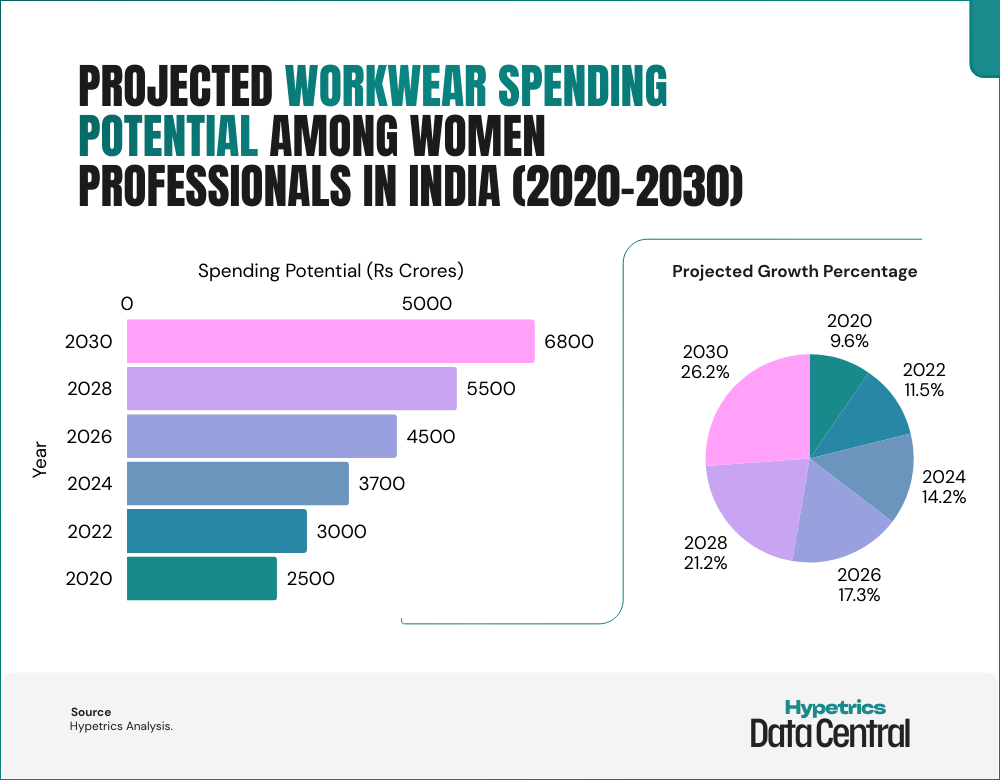
As participation of women in the professional workforce in India grows, the spending potential on structured workwear is increasing. Internal industry modelling indicates that the consumption of workwear by professional women in urban areas may already be a Rs 6000- 6800 crore opportunity by the year 2030
According to the Hypetrics modelling framework, if 30 – 35 percent of India’s estimated 43 million urban women professionals allocate ₹10,000–₹15,000 annually toward workwear, the category could represent a ₹4,500–₹6,000 crore addressable segment within the broader women’s apparel market.
Despite the high growth rate in the women’s fashion industry in India, much of the industry remains based on assumptions about how women in India dress, not on how they actually dress in their day-to-day professional lives.
For women, dressing up for work is not about how they look, but how they manage.
Dressing up in formal clothing can be about how they manage to keep it comfortable throughout their commute and at work. It can be about how they manage with clothing that was made with assumptions about how people in other, cooler places dress. It can be about how they manage with clothing that was made with assumptions about how women’s bodies are proportioned in India.
The disconnection between professional clothing and professional life is where Label Aeris, started by Ridhima, comes in. Label Aeris does not look at work clothing as an industry that is driven by trends.
Women’s workwear in India still borrows from Western power dressing, often overlooking the comfort real workdays actually demand.
Ridhima
When a Founder’s Experience Reflects a Broader Category Pattern.
Ridhima’s foray into the workwear industry was not based on fashion entrepreneurship. Rather, it was a culmination of her own experiences in corporate environments where professional appearance was implicitly linked with certain expectations, but there was a lack of support in practical applications. She noticed a trend in all workplaces where women in her professional circle would often find a certain degree of compromise in professional dressing. A certain level of polish in professional appearance was often linked with a compromise in comfort, and a certain level of comfort was also linked with a lack of authority in a professional context.
The issue was deeper. A certain level of polish in professional appearance also required a certain degree of extra effort and mental preparation before the actual workday began.
A certain number of outfit tests, a certain degree of consideration for commuting conditions, and a certain level of concern for how others would perceive them in a professional context were also a part of a larger, albeit unstated, trend. This gradually led to a larger realization regarding a structural gap in the larger context.
This led to the creation of Label Aeris.
The Quiet Cognitive Load of Professional Dressing
Professional wardrobes are not commonly considered a source of daily cognitive load, but they are.
The analysis of wardrobes of urban professionals reveals that women generally own between 20 and 25 garments that could be considered workwear, but only use a mere 6–8 of them regularly.
The gap between the volume of the wardrobe and usability is a problem that has been created by the industry, where variety is increased, but usability is not.
Women professionals are expected to manage multiple demands and expectations:
• Professionalism without rigidity
• Comfort without informality
• Authority without excessive styling
The problem is a source of decision fatigue, which is generally unnoticed and occurs even before the work day begins.
Ridhima presents the problem as a design oversight rather than a styling problem: If garments need constant adjustments and second-guessing, it may be that they were never designed with the needs of women professionals in mind.
Label Aeris and the Capsule Wardrobe Framework
The problem of wardrobe creation is addressed through the philosophy of capsule wardrobe.
The brand does not promote a high turnover of wardrobe items. Instead, Label Aeris offers a range of essential wardrobe items that can be mixed and matched with each other in various combinations.
Breaking Away from the Legacy of Power Dressing
Professional fashion has been dominated by the visual language of power dressing for decades now.
Suits, Blazers, and Tailoring were essentially associated with power in a corporate setting.
However, these parameters were essentially set within a Western framework.
Indian working professionals are essentially living in a different reality.
Daily commutes are over 60–90 minutes daily, and work hours are well past office hours as one has to attend business meetings or travel for work purposes.
In such a setting, power dressing is essentially no longer practical.
Professionals seem to be increasingly favoring clothing that is practical over those that are visually powerful.
Ridhima describes her design philosophy in these words: “Clothing should not dominate your day. Instead, it should help you through your day.”
Reasons Why Capsule Wardrobes Are Resurfacing in Professional Fashion
The capsule wardrobe movement has its roots in the 1970s, during which time designers started advocating for smaller wardrobes containing versatile pieces that are able to deliver multiple outfit combinations.
However, today the capsule wardrobe is resurfacing for various reasons related to practicality.
Professionals are increasingly embracing routines that help them avoid decision fatigue. For them, having a smaller yet more versatile wardrobe could be advantageous in ensuring uniformity in work attire without having to shop extensively.
Consumer behavior is already providing initial indicators that this is happening.
Buying habits among urban professionals are showing signs that they are increasingly interested in having a smaller yet more versatile wardrobe, where frequency of wear is a stronger purchasing motivator than product uniqueness.
Label Aeris is a brand that is positioning itself on this shift in consumer behavior.