India’s tourism sector is moving into a decisive new phase. The data across 2022-2025 makes it clear that this is no longer a story of recovery. It’s a story of acceleration. With billion-plus domestic visits, rising foreign exchange earnings, and a long-term forecast pointing to strong compounding, India is building one of the most powerful tourism-led economic engines in the world. The momentum is not accidental. It is structural. And it is reshaping the business model of tourism across states, destinations, and travel brands.
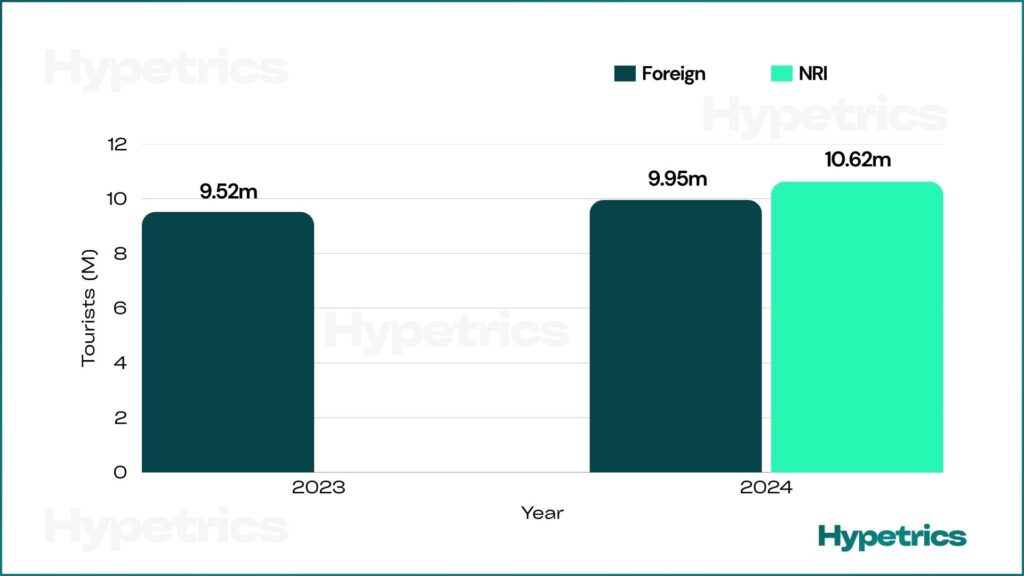
In 2023, India received 9.52 million foreign tourist arrivals. In 2024, international arrivals reached 20.57 million, comprising 9.95 million foreign tourists and 10.62 million NRIs. That rebound is significant because it places India back in the global tourism flow, but the real lesson lies in spending patterns. Tourism generated USD 28.07 billion foreign exchange earnings in 2023. Provisional FEE for the first half of 2024 already stands at ₹1.27 lakh crore. India may still be rebuilding its foreign arrival volumes, but the value per traveller is rising. Medical tourism, luxury itineraries, spiritual tourism, and premium hospitality are emerging as high return categories. This is where the next phase of growth will be defined. India does not need to chase volume at the cost of yield. It needs to attract travellers who come with intent to spend.
But the real backbone of India’s tourism economy is domestic mobility. The country recorded 2.509 billion domestic tourist visits in 2023. In 2024, this surged to nearly 2.95 billion, up 17.51%. This is one of the strongest domestic tourism movements globally. Such scale changes the economics of travel. It allows hospitality chains, transport operators, food and beverage brands and local experience providers to build stable, year-round demand. It also means India can design a tourism model that is resistant to global volatility. When international markets slow down, domestic demand holds the fort.
It also fuels India’s labour market. According to data provided by the government, tourism created 76.17 million direct and indirect jobs in 2022 to 2023. WTTC reports 46.5 million tourism-supported jobs in 2024 and expects close to 64 million by 2035. Few industries pack this degree of employment density with regional distribution. Tourism employs people at airports, temples, hill stations, heritage clusters, restaurants, homestays, local craft ecosystems, and travel technology networks. This sector is not only a contributor to GDP; it’s a contributor to livelihoods.
On the economic front, the tourism sector contributed 5 percent to India’s GDP in 2022 to 2023. WTTC estimates the sector contributed INR 19.13 trillion in 2023. By 2025, it could reach INR 22.5 trillion. By 2035, the number could stand near INR 41.9 trillion, approximately 10.9 percent of GDP. These figures signal that tourism is evolving into a long horizon economic pillar. It is not seasonal. It is not peripheral. It is central to India’s growth story.
This shift is reflected in the rise in competitiveness. India moved from rank 65 in 2014 to rank 39 in the 2024 Travel and Tourism Development Index. Investment is backing this improvement. The Centre allocated ₹2,479 crore to the tourism sector in FY 2025 and continues to deploy capital through schemes like Swadesh Darshan and Special Assistance to States for Capital Investment. Add to this the expansion of airports, highways, smart transport systems, Vande Bharat routes, and planned high speed rail. Tourism is an infrastructure story as much as it is a hospitality story.
This infrastructure unlocks new corridors. Destinations that once struggled with accessibility are now entering mainstream travel circuits. States traditionally dependent on seasonal tourism are now looking at niche categories such as adventure tourism, eco tourism, and wellness tourism.
The business model is shifting from fragmented operators to integrated experience platforms. Technology is becoming a differentiator as travellers demand seamless planning, digital concierge services, cashless convenience, and credible information access. Yet, growth brings responsibility: Sustainability, heritage protection, and crowd management will increasingly be non-negotiable. With billions of domestic travellers and growing foreign interest, India needs to ensure that economic growth doesn’t come at the cost of environmental or cultural assets. Indeed, over the next decade, regulation, responsible tourism frameworks, and destination management systems will require equal focus.
The momentum is clear. India is building a multi trillion rupee tourism engine powered by domestic volume, rising foreign spending, strong employment generation, and aggressive infrastructure development. The opportunity now is to convert momentum into long term value. This is the decade that will define India’s place in the global tourism economy.